
Unitaid at AIDS 2026
AIDS 2026, the 26th International AIDS Conference, takes place in Rio de Janeiro, Brazil, and virtually, from July 26-31, 2026, under the theme “Rethink. Rebuild. Rise.” The conference brings together people living with HIV, researchers, policymakers, healthcare professionals, funders, media, and communities at a critical juncture for the global HIV response, as an unprecedented funding crisis and cutbacks to HIV programs threaten decades of progress.
As Unitaid marks its 20th anniversary, AIDS 2026 arrives at a pivotal moment to reflect on two decades of catalytic investment while looking ahead at the future of health innovations and access. The conference is an opportunity to show how Unitaid’s investments are shaping a more resilient, equitable HIV response: accelerating access to long-acting prevention options like lenacapavir, strengthening diagnostics and market access, and supporting community-led delivery models that get innovations to the people who need them most.
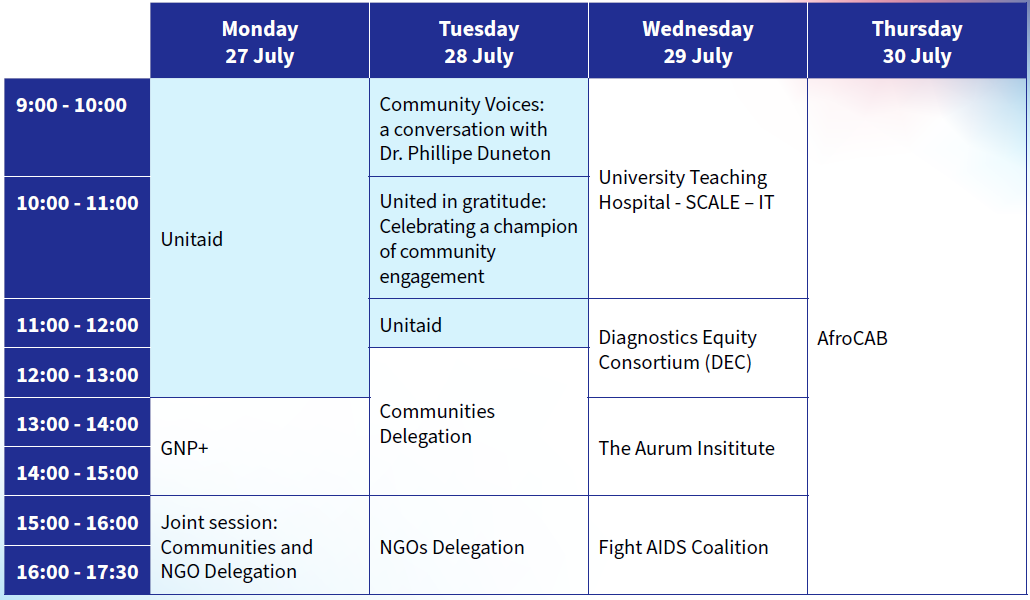
Pre-conference session, co-organized by PATH, Unitaid, International Community of Women living with HIV—Eastern Africa, World Hepatitis Alliance, Evidence Action, World Health Organization
Pre-conference session, organized by ITPC
This opening session provides a political overview of the current moment and what it echoes. While scientific innovation continues to accelerate, many communities are confronting uncertainty around the sustainability of prevention, treatment, advocacy, and community-led programs, and a troubling return of the false choice between treatment and prevention that the movement rejected in the early 2000s. Shrinking donor funding, weakening multilateralism, rising conservatism, and rapid technological change are reshaping the HIV response and the future of treatment activism.
Bringing together different generations of activists and community voices, the session reflects on how previous movements navigated earlier periods of crisis and what lessons remain relevant today. It also questions whether existing advocacy models, organizing methods, and funding structures remain fit for a more fragmented and unequal global environment. The session sets the political foundation for the pre-conference by framing the current moment not only as a crisis of access, but also as a crisis of sustainability, solidarity, and movement strategy.
Satellite session, co-organized by Unitaid, the Gates Foundation, and WHO
Substantial investments have been made with HIV prevention implementation studies of oral PrEP, dapivirine vaginal ring, cabotegravir, and lenacapavir. As countries move toward multi-product PrEP markets and prepare for lenacapavir introduction, there is an urgent need to synthesize and translate lessons from these studies into actionable policies and program strategies that can accelerate equitable access and sustained use. The session session objectives are to: ? Share recent evidence from implementation studies of PrEP choice, including early lenacapavir implementation studies, and highlight implications for national policies and product introduction plans. ? Describe promising differentiated service delivery models for integrating injectable lenacapavir alongside other PrEP options. ? Identify remaining evidence gaps and priority implementation research questions related to PrEP choice and lenacapavir rollout, and offer evidence-informed insights
Satellite session, co-organized by PATH, ICWEA, WHA, Unitaid, WHO, and PAHO
The world has committed to eliminating vertical transmission of HIV, syphilis, and hepatitis B by 2030, yet progress has stalled due to siloed delivery platforms and fragmented systems. As countries now face the challenge of recalibrating their HIV and broader health responses amidst a shrinking health fiscal space, building EMTCT responses on integrated delivery platforms and systems is more critical than ever. This pragmatic session will showcase EMTCT initiatives advancing people-centered, life-course-based care delivered through integrated platforms. This session will feature pathways and tools used to sustainably advance integrated systems and delivery models; case studies showcasing the impact of bundled care on health and systems outcomes; and wrap with a expert panel of government and community representatives, practitioners, and donors sharing lessons and considerations for countries as they work towards rebuilding sustainable systems and EMTCT platforms that put people first
Satellite session, organized by PAHO
HIV-related mortality in LAC remains unacceptably high, driven by late HIV diagnosis, delayed ART, and limited management of AHD. Challenges in retention in care and achievement of viral suppression further increase the risk of poor outcomes.
This symposium will position HIV-related mortality reduction as a central pillar of the elimination agenda including the contribution of regional OIs such as histoplasmosis. It will present regional trends and successful country experiences on people-centered approaches for early diagnosis, rapid testing for OIs, and improvement of access to critical commodities. Through combined political and technical dialogue, the session will emphasize leadership, accountability, and coordinated action to accelerate progress toward zero AIDS-related deaths by 2030 and close the remaining gaps across the Region.
Satellite session, co-organized by Population Services International, CIFF, Wits RHI, CHAI
As a highly effective, twice-yearly subcutaneous injectable, lenacapavir (LEN) has the potential to transform HIV prevention programming by addressing long-standing challenges related to adherence, access and choice. Realising this potential will require deliberate, Ministry-led introduction strategies, particularly in the context of competing health priorities, and a rapidly shifting global financing landscape. This satellite session brings together representatives from early-adopter countries and technical partners to share practical insights from the first wave of LEN introduction across Southern and Eastern Africa. Speakers will present early lessons from regulatory and policy preparation, supply chain and health system planning and innovative demand-creation approaches, including digital and AI-enabled tools. The discussion will examine how LEN is expanding prevention choice, strengthening person-centred service delivery, and shaping national HIV prevention strategies.
Satellite session, organized by WHO
WHO clinical, service delivery and surveillance updates: new recommendations for HIV and sexually transmitted infections The session will focus on the latest WHO recommendations on the prevention, diagnosis and treatment of HIV, and STIs. The session will also explore the perspectives of key stakeholders on how these new recommendations can impact the public health response to these diseases, taking to account the main changes, innovations and implications for policy and practice different settings. The audience will have the opportunity to ask questions and provide feedback to the speakers and the co-chairs.
Global Village session, organized by Wits RHI and PrEP1519
Traditional health outreach often misses the mark with vulnerable youth, who don’t speak its language. This hands-on workshop turns social media from a social space into a demand-creation tool for PrEP, equipping young peer educators with the skills to produce high-impact, culturally resonant digital content. Participants will learn to navigate digital norms and craft accessible, wide-reaching campaigns that meet adolescents where they already are.
Satellite session, organized by Unitaid
Unitaid will convene a high-level flagship satellite event marking 20 years of HIV innovation for impact, highlighting how strategic investment in innovation remains essential in a constrained global health financing environment. The event will reflect Unitaid’s full value chain, from identifying game-changing innovations to shaping markets and enabling equitable access at scale. The discussion will spotlight lessons from two decades of HIV innovation, including long-acting technologies such as lenacapavir (LEN), and explore what is required to accelerate access to the next generation of prevention and treatment tools. The session will intentionally center the perspectives of people living with HIV and affected communities, representatives from Ministries of Health in LMICs/high burden countries, alongside policymakers, implementers, researchers, and funders, reinforcing Unitaid’s commitment to people-centered innovation and impact.
Symposium, organized by IAS
This session will re-imagine philanthropy’s social contract. How are philanthropic funders rethinking their business models and accountability to affected communities amid shrinking global aid and rising national leadership? What does the way in which philanthropic organizations are operationalizing recent commitments – on access to innovations and the shift toward locally led funding architectures – tell us about the dynamics of power and partnerships?
We will also look ahead. What is the long-term relevance of HIV philanthropy amid increasing calls for domestic funding, regional blocs and structural reform? What must change now to remain credible and impactful?
Symposium, organized by IAS
The session will bring together representatives from communities, private and public partners, policy makers and scientists to highlight innovative ways of communicating, implementing and sustaining partnerships that translate science into action.
Satellite session, co-organized by Medicines Patent Pool, PAHO, Unitaid
While TLD remains the most used HIV treatment globally, a growing range of non-TLD regimens — including TAF-based regimens, oral dual therapy, and long-acting dual injectable treatments — are now recommended by WHO offering important opportunities to optimize treatment for different populations. However, awareness of these options and of their access pathways remains uneven, and their implementation varies widely across regions. In Latin America and the Caribbean, countries are exploring treatment simplification and cost reduction opportunities that oral dual therapy offers, in particular as a strategy to reduce long-term toxicity from tenofovir, in settings where access to generic TAF-based regimens is limited. There is also interest in emerging treatments, such as long-acting injectable cabotegravir and rilpivirine. Given how widespread and affordable TLD has become, ensuring sustainable procurement and equitable access remains a central consideration in exploring any of these options.
This session will provide a global overview of the evolving landscape of non-TLD antiretroviral regimens and discuss how these innovations can translate into real impact for people living with HIV. A regional focus on Latin America and the Caribbean will highlight implementation opportunities and challenges, including from an access and equity lens.
Satellite session, organized by Wits RHI, CHAI and PSI
The satellite will share lessons across a multi partner consortium (Wits RHI, CHAI and PSI) garnered from early LEN introduction, and TA support offered to 9 early LEN adopter countries. Successfully introducing new HIV prevention options such as LEN requires both clarity in how demand generation is defined and structured, and alignment with service delivery systems to enable uptake at scale. Therefore speakers will focus on demand generation as a critical component of the product introduction pathway and will present cross-country implementation learnings and introduce a structured demand generation playbook that supports effective introduction and uptake of Lenacapavir within a broader PrEP Choice framework.
Satellite session, co-organized by the Aurum Institute, DNDi, and Unitaid
Advanced HIV Disease (AHD) is the predominant cause of admissions and deaths among people infected with HIV, caused by disparities in access and breakdown along the HIV cascade. Outbreaks such as Mpox present additional risk among PLHIV with AHD who has weakened immune system, increasing the risk of death. The IMPAACT4HIV project, funded by UNITAID, addresses critical gaps and generates timely implementation evidence by integrating the AHD package of care in several countries across Africa. This session brings together implementers, clinicians, communities, and researchers to share evidence using routine and outbreak data to inform decentralization and entry-point decisions for AHD in routine HIV care and the Mpox response. Findings from project implementation, including the hub-and-spoke model, point-of-care diagnostic uptake (CD4, TB-LAM, CrAg), bi-directional integrated models, supply chain realities, and operational lessons under current funding constraints, will be presented.
Satellite session, organized by CHAI
Despite progress in HIV treatment, AIDS-related mortality remains high, with 630,000 deaths in 2024, underscoring the urgency of improving AHD care, particularly among children. As countries shift toward integrating HIV and primary health care systems, particularly in the context of an evolving funding landscape, this presents both opportunities and risks. While integration can expand access and improve efficiency, it can dilute focus on AHD, disrupt commodity access, and weaken referral and retention if not deliberately designed.
Drawing on the Unitaid-funded THRIVE project, implemented by CHAI in partnership with AFROCAB and Penta, this session will examine how integration is playing out in practice. Country and community perspectives will highlight where systems are working, where gaps are emerging, and implications for people living with HIV. The session will conclude with a panel discussion identifying priorities to protect and sustain AHD services within evolving health systems.
Satellite session, co-organized by PATH, AVAC, UNAIDS, WHO, Unitaid, APCOM, ICWEA, Harvard, Frontline AIDS, and the Elton John AIDS Foundation
While annual HIV infections have declined by nearly 40% since 2010, the rate of decrease has stagnated, with 1.3 million new cases reported in both 2023 and 2024, driven by increasing or flatlining incidence in Asia, Latin America, Central and Eastern Europe, Middle East and North Africa, and larger relative numbers of new HIV acquisitions in Africa. At the same time, since early 2025, financing for HIV prevention—including condoms, PrEP and PEP, VMMC, harm reduction, and EMTCT has declined substantially. This dynamic session will quantify funding gaps and feature country reforms as well as innovative financing and delivery solutions to sustain prevention—from integrated primary health care and key population-led private-sector models to total market approaches and the role of national health insurance. The session culminates with considerations from a panel of community, government, private-sector, and donor representatives on how to
Plenary, organized by IAS, chaired by Unitaid
Symposium, co-organized by Unitaid and Fiocruz
Implementation studies offer critical evidence for integrating new HIV prevention technologies into public health policy and practice, by identifying effective delivery strategies, adapting workflows, and expanding access for vulnerable populations. Drawing on the ImPrEP CAB and ImPrEP LEN Brasil studies, which evaluate persistence with long-acting PrEP and the effectiveness of same-day PrEP among sexual and gender minorities in Brazil’s public health system, this symposium shares evidence and lessons from implementing long-acting PrEP across Latin America. Topics include education to support informed PrEP choice, demand-generation strategies for vulnerable groups including SGM adolescents, patterns of switching and discontinuation, barriers and facilitators to integrating long-acting PrEP into routine services, and the cost-effectiveness of these approaches.
Satellite session, organized by Wits RHI
Project PrEP and its partners are redefining how digital technologies complement, rather than replace, human relationships in health care. This session unpacks the “human algorithm” at the heart of that work: a living ecosystem of tools, data, and people, tracing how AI-enabled chatbots like Sister Unathi, the myPrEP.co.za service finder, WhatsApp-based client navigation, and youth-centered digital platforms combine with peer networks, provider empathy, and lived experience. Together, these create real-time feedback loops that strengthen demand generation, improve service linkage, and support informed PrEP choice across oral PrEP, the DVR, CAB-LA, and lenacapavir, raising a critical question: how can digital intelligence and human insight co-design the next generation of HIV prevention?


