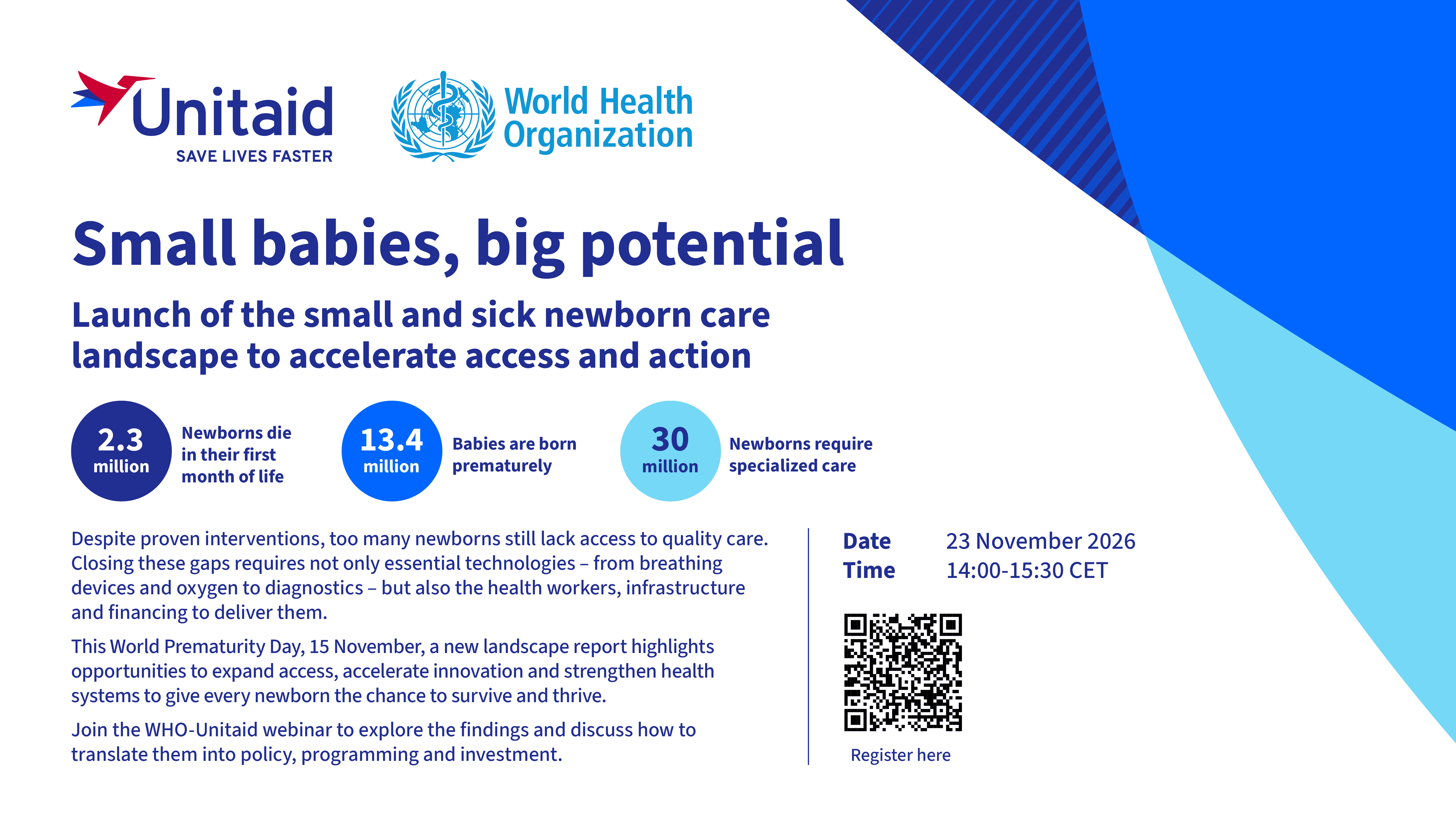
Ahead of World Prematurity Day on 15 November, Unitaid is highlighting an urgent opportunity to accelerate progress for babies born too soon, too small or who become ill during the newborn period. For more than one in four babies born globally, these complications can make the first month of life especially vulnerable. Small and sick newborns account for more than half of the estimated 2.3 million newborn deaths each year, with the greatest burden concentrated in low- and middle-income countries.
Unitaid’s new Small and Sick Newborn Care Landscape examines 98 medicines, diagnostics and devices, alongside service delivery innovations, to identify opportunities to improve care and outcomes for these newborns. The report identifies opportunities to expand access to priority interventions, address important product and market gaps, and strengthen the delivery of quality newborn care.
Improving access requires more than individual products or interventions: it depends on interconnected health system elements working together to deliver reliable, high-quality care. This includes trained health workers, appropriate infrastructure, reliable supplies and equipment maintenance, referral pathways, sustainable financing and continuous quality improvement. Strengthening district-level newborn care is particularly important to bring essential interventions closer to the families and communities that need them.
The findings reinforce an important reality: the greatest opportunity before us is not simply to develop new solutions, but to ensure that proven solutions reach every newborn who needs them. By strengthening care for small and sick newborns, investing in resilient health systems, and supporting families and communities, we can save lives and improve lifelong outcomes for countless children.
Honourable Madalitso Chidumu Baloyi
Minister of Health and Sanitation of the Republic of Malawi
The landscape points to several areas where governments, manufacturers, funders and implementing partners can accelerate progress. These include expanding access to proven interventions, delivering integrated packages of respiratory and supportive care, improving affordability, availability and supply security through market-shaping approaches, and investing in innovations designed for the realities of low-resource health systems.
On 23 November at 14:00-15:30 CET, the World Health Organization and Unitaid will host a webinar bringing together newborn health experts to explore the report’s findings and discuss how to to translate them into policy, programming and investment to accelerate progress towards ending preventable newborn deaths by 2030.